
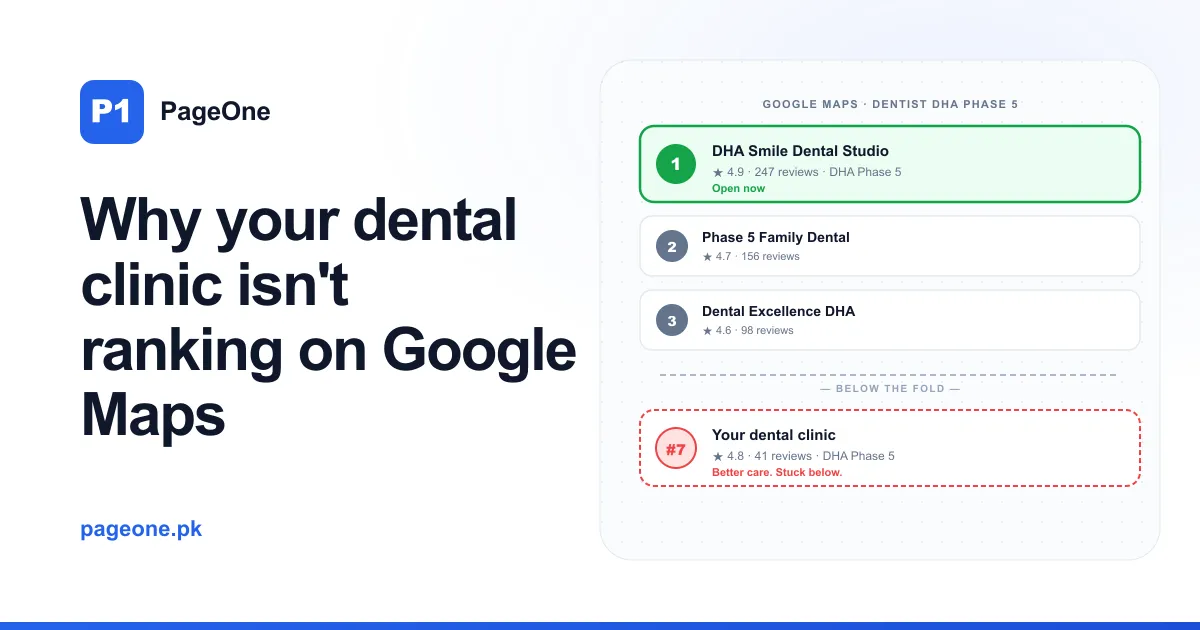
A patient in DHA Phase 5 opens Google Maps and types “dentist near me.” Three clinics appear in the highlighted top block, the Map Pack. Two more show below the fold. None of them are yours. You search again the next day from your own phone and still don’t find your clinic until you scroll into the second screen. Meanwhile, the clinic three streets over with the much smaller practice and visibly older equipment shows up at the top, every time.
It’s the single most common frustration Pakistani dental clinic owners describe. The hard part isn’t fixing it. Most clinic owners can do the work in a few weekends. The hard part is realising that Google Maps doesn’t rank clinics by how good the dentist is, how clean the chairs are, or how many patients they’ve successfully treated over the years. It ranks them by signals it can measure automatically and at scale. None of those signals involve clinical quality. All of them are things you can audit and improve.
This post walks through the seven reasons, in roughly the order that matters most for Pakistani dental clinics in 2026.
1. Your GBP either isn’t claimed, or it is but it’s half-empty
The number-one ranking signal is whether Google can verify the listing belongs to a real, present business. An unclaimed listing (the auto-generated stub Google creates from old directory data) almost never ranks in the Map Pack. A claimed-but-half-empty listing ranks below a competitor whose listing is filled out completely.
Go to business.google.com and search for your clinic. If the entry says “Claim this business,” that’s your week-one job. The full step-by-step is in the separate how to claim your GBP in Pakistan walkthrough.
If you already own the listing, open it and check whether every field is filled in: address, phone, hours including Friday and holiday closures, full 750-character description, every category that applies, the services list, the photo grid, and the Q&A. Most half-empty listings have big gaps: missing hours, no services list, no description, an empty photo grid. Filling them in is the highest-leverage GBP work you can do this month.
2. The wrong primary category, or only one category claimed
This single mistake costs more Pakistani dental clinics their rankings than any other. Google asks you for a primary category and lets you add secondaries. Most clinic owners pick “Dentist” as primary and stop.
A real Pakistani dental clinic almost always qualifies for four to seven categories: Dentist (primary), then Cosmetic dentist, Family dental clinic, Pediatric dentist, Orthodontist, Dental implants periodontist, Emergency dental service, Oral surgeon, depending on what you actually do. A clinic that claims one category and skips the rest competes for the patients searching the one term it claimed. A clinic that claims six relevant categories competes for six search-term clusters in parallel.
The discipline is honest: only claim categories where you genuinely deliver the service. Padding the list with categories you don’t really do gets the listing flagged or suspended. But underclaiming is the more common Pakistani failure mode. Most clinics could legitimately claim three or four more categories than they currently do.
3. Reviews: too few, too old, or all from the same week
Reviews are one of the strongest signals feeding a profile’s prominence in the Map Pack, and they’re the signal most clinics underinvest in.
Google looks at three things: how many reviews you have, how recent they are, and how natural the cadence looks. A clinic with 87 reviews accumulated steadily over three years outranks a clinic with 150 reviews where 120 arrived in the same fortnight (that pattern reads as paid or coerced and gets discounted). A clinic with 41 recent reviews from the last six months ranks above a clinic with 92 reviews where the most recent is from 2023.
The fix is operational, not technical. After every completed appointment (cleaning, extraction, follow-up, anything that ends with a satisfied patient walking out) the clinic asks for a review. Not via printed flyer. Not via email. Via WhatsApp, with a direct link to the review form pre-filled. The front desk does it in the thirty seconds while the patient is settling the bill. Done consistently, a busy family dental clinic can realistically add several new reviews a month, and over a few months that compounds.
A few rules. No buying reviews from a marketplace. Google’s fraud detection in 2026 catches almost all of them, and the penalty is suspension. No incentivising reviews (“get a free check-up if you leave a five-star”), also a policy violation. The review you ask for needs to be honest; the only thing you control is whether the patient remembers to leave one at all.
4. NAP inconsistency
Your business name, address, and phone number (NAP) should be identical everywhere it appears: your GBP, your website footer, your Facebook page, your Healthwire profile, your Marham listing, your Yellow Pages PK entry, old directory pages from 2019 that nobody has updated.
When Google sees the same clinic with three slightly different addresses across the web (“Plot 12, DHA Phase 5” vs “House 12, DHA Phase V, Lahore” vs “12-A DHA Phase V”), it can’t confidently confirm any of them. The signal weakens. Listings with crisp NAP consistency across ten or twenty mentions on the web rank above otherwise-equivalent listings with inconsistencies across the same surfaces.
The audit is tedious but mechanical. Search for your clinic name in Google and click through every result that mentions an address or phone. Make a list of the variations. Pick one canonical version, and update every result you control. For results you don’t control (legacy directories, old aggregator pages), use the contact-correction flow on each one. Most accept corrections within a few weeks.
5. The listing has gone dormant
A claimed, completed listing that hasn’t seen activity in six months ranks below one that gets a new Post weekly, fresh photos monthly, and a review every fortnight. Google’s algorithm reads recent activity as a signal that the business is real, open, and worth showing to a patient asking for one right now.
What “activity” means in practice:
- A Google Post every week. Topic can be anything: clinic timings before Eid, a new service launch, a hygiene tip, a price clarification. Two sentences plus a photo. Takes five minutes; pays off for the next 90 days of rankings.
- Fresh photos every month, three or four new shots. Interior, equipment, team, before/afters with consent. Stock images don’t count; Google’s image-detection flags them.
- Q&A responses. New patient questions appear silently in your Q&A section. Answer them yourself within a day. Better: pre-load 10-15 common questions so your answers are first.
- Review responses to every review, positive or negative, within a week. Negative review responses follow PMDC rules: acknowledge the concern, don’t disclose clinical details, take it offline.
Most Pakistani dental clinics treat the GBP as a one-time setup. The clinics that rank treat it as a weekly ten-minute responsibility. The compounding gap is one of the largest single sources of ranking difference in any neighbourhood.
6. Your website doesn’t reinforce the listing
GBP is the single biggest signal but it’s not the only one. Google cross-references your listing against your website, and any mismatches dilute confidence.
Three specific website issues commonly hold dental clinics back:
- The website’s contact page lists a different address or phone than the GBP. Even small differences (suite number missing, “Plot” vs “House”) count.
- The site has no schema markup identifying it as a dental practice. Modern dental sites should declare
LocalBusinessandDentistschema along withMedicalBusinessso Google understands the page and the listing are about the same entity. - The site loads slowly on mobile, especially over Pakistani 3G or load-shedding-thinned 4G. A site that takes seven seconds to load above the fold gets fewer clicks from the Map Pack, which feeds back into the ranking signal.
For a dental clinic in particular, the underlying website’s quality compounds the GBP ranking work. Our web development playbook for dental clinics covers the schema, speed, and conversion-flow details a Pakistani dental site should ship with.
7. You’re targeting the wrong geography
A clinic in DHA Phase 5 Lahore that optimises for “dentist Lahore” competes against every clinic in the city. The patient who’s actively about to book, though, doesn’t search “dentist Lahore.” They search “dentist DHA Phase 5” or “dentist near me.” The geography that matters is neighbourhood-level, not city-level.
Map Pack rankings are calculated per location. A clinic genuinely optimising for “dentist DHA Phase 5” (neighbourhood mentioned in the GBP description, in the website’s title tags, in service-page headers, with neighbourhood-specific patient reviews) outranks a clinic in the same DHA Phase 5 building that only targets “Lahore.” Most Pakistani dental clinics target the city and miss the neighbourhood. The clinics that target the neighbourhood quietly take the patients.
For specific examples of what neighbourhood-level dental optimisation looks like, the Lahore dental Local SEO playbook lays out DHA Phase 5, Gulberg, Johar Town, Model Town, and Bahria Town-specific signals.
How to diagnose your specific problem
Before fixing anything, figure out which of the seven is your binding constraint. The cheapest way is to compare your listing side-by-side with the clinic currently sitting at Map Pack position one in your neighbourhood. Open both. Note every difference.
If the top clinic has 240 reviews and you have 18, your binding constraint is reviews. If the top clinic has 6 categories and you have 1, your binding constraint is categories. If the top clinic has a Post from this week and your last activity is from October 2024, your binding constraint is dormancy. If the top clinic has a clinic-specific website with schema and you have a generic WordPress page from 2019, your binding constraint is the site.
The hardest part of dental ranking work in Pakistan isn’t doing more things. It’s doing the right thing first. Most clinics try to fix all seven at once, run out of energy, and finish none.
Realistic timelines
Once you’re working on the right constraint, the improvement timelines look roughly like this in a Pakistani dental neighbourhood:
- Claim and complete the GBP: visible in the Map Pack for low-competition neighbourhood searches within 2-4 weeks.
- Add missing categories: measurable change in 4-8 weeks as Google indexes the additional category targeting.
- Review velocity from operational workflow: Map Pack movement noticeable at 30 new reviews, durable at 80.
- NAP cleanup: slow compounding over 6-12 weeks.
- Weekly activity (Posts, photos, Q&A): quietly improves rankings over months; the gap vs dormant listings widens permanently.
- Website schema and speed: supports the above; alone, marginal.
- Neighbourhood targeting: when paired with reviews, this is the move that takes a clinic from “occasionally in Map Pack” to “anchored at the top.”
The honest summary: there’s no quick fix that lasts. The clinics that hold the top three Map Pack slots in DHA Phase 5, Gulberg, or PECHS Karachi got there through 6-12 months of disciplined weekly work. The clinics in positions 7-15 mostly haven’t done that work consistently. That gap is the whole game.
An honest close
Pakistani dental clinic owners are some of the hardest-working professionals you’ll meet. The frustration of watching a less-good clinic rank above you is real. The good news is that the work to fix it isn’t clinical. It’s operational. Most clinic owners can run the audit, identify the binding constraint, and start fixing it themselves in a few weekends.
If you’d rather have a written audit comparing your listing against your top three neighbourhood competitors, with a prioritised list of the three things to fix first, get in touch. I’ll send one back within 3 business days, free, no obligation. If you’d rather have someone else handle the ongoing weekly work, that’s what PageOne’s local SEO service for dental clinics covers, and pricing is on the pricing page in transparent PKR.
The wider dental-marketing context, including the three pillars (web, local SEO, GBP) and how PMDC compliance threads through all of them, is on the dental clinics hub. And if the PMDC question is what’s making you cautious about review responses or Posts, the PMDC advertising rules for Pakistani clinics post is the companion piece to this one.
