
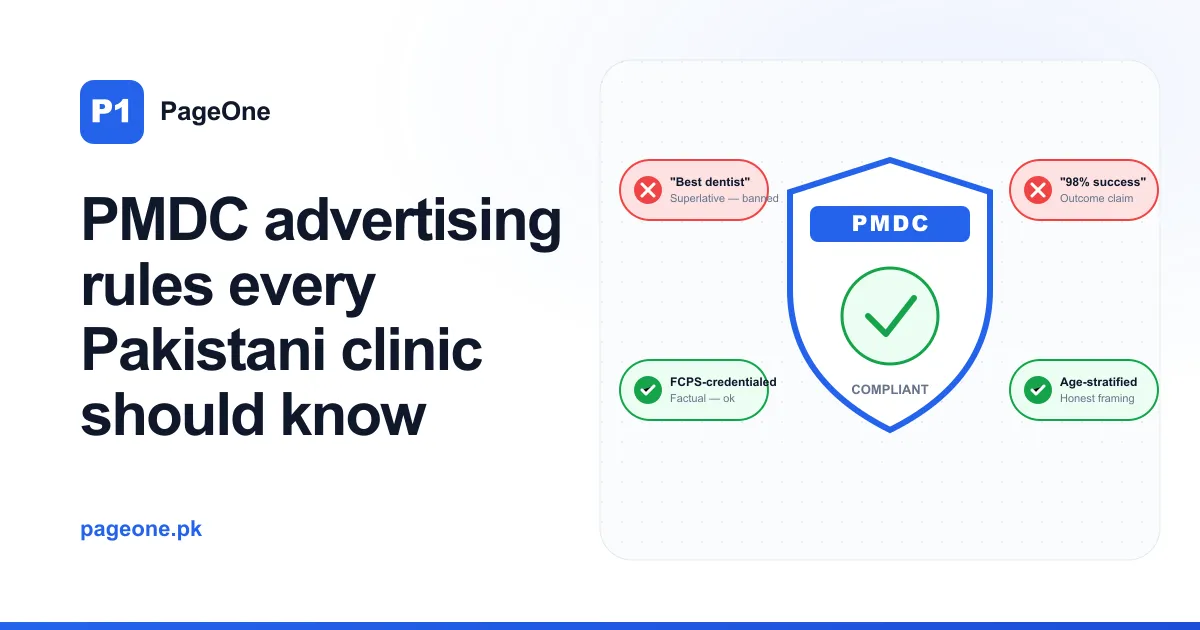
The Pakistan Medical and Dental Council (PMDC) is the statutory body that licenses doctors and dentists in Pakistan, and its Code of Ethics has a section on advertising that most clinic owners have never actually read. The short version: PMDC restricts superlative claims, guaranteed outcomes, comparative advertising, misuse of before/after photographs, and testimonials that conflate one patient’s experience with general clinical results.
This piece walks through the five compliance failures that show up most often on Pakistani clinic websites and Google Business Profiles, and what to do instead. It is written for clinic owners, not for medical lawyers, so the focus is on practical patterns you can fix this week.
(a) “Best dentist in Lahore” and other superlative claims
Superlatives are the most common PMDC issue, and also the easiest to fix. A superlative is any claim that positions your clinic as the highest-ranked option in a category: “best”, “top”, “leading”, “number one”, “most trusted”, “Pakistan’s #1”, “Lahore’s premier”. PMDC’s view is that these claims are unverifiable by patients and inherently misleading, because no clinic can substantiate “best” against every competitor in a city.
The trap most owners fall into is the rebrand: “best” becomes “most trusted” or “premium” or “award-winning” or “pioneer”. PMDC reads those as the same category of claim. A clinic owner once told me they thought “most-trusted” was safer than “best” because it implied patient sentiment rather than ranking. It isn’t. The standard is whether the claim is verifiable. “Most-trusted” isn’t.
The safe replacement is positional and factual. Instead of “best dental clinic in DHA Lahore”, write “DHA Phase 5 dental clinic, open since 2017, FCPS-credentialed”. Instead of “Pakistan’s leading hair transplant surgeon”, write “Hair transplant surgeon with 12 years of FUE and FUT experience, MBBS PMDC-registered”. The factual version actually performs better in local search anyway, because Google’s algorithm rewards specificity (neighbourhood, credential, procedure) more than puffery. On a dental clinic or hair transplant clinic page, removing unprovable superlatives and leading with credentials tends to build more trust, not less.
(b) Before/after photos without documented per-patient consent
Before/after photographs are not banned. They are heavily conditional. PMDC’s position is that any identifiable patient image used in marketing requires the patient’s specific, written, informed consent for that specific use, meaning consent for use in marketing, not just consent for the procedure or for the photo itself to exist in clinical records.
The three patterns that get clinics in trouble:
- Consent collected once, used everywhere. A patient consents to a photo for the clinic’s records during her PRP treatment, and two years later it appears in a Facebook ad. That’s a fresh use and needs fresh consent.
- No consent withdrawal process. A patient sees her photo on the clinic’s site, asks for removal, and the clinic takes three months. PMDC and the patient’s medical lawyer both treat that delay as a problem. The safe default is a documented same-week removal SLA, with a single email address that handles requests.
- Faces fully identifiable in marketing carousels. Even with consent, the safer pattern is partial obscuration (eyes covered, lower face only for dermatology, scalp-only for FUE), captioning that describes the technique rather than the transformation, and embedding photos inside the relevant procedure page, never as a floating homepage carousel where the same patient’s image appears next to unrelated services.
This applies most to skin clinics doing aesthetic dermatology, hair transplant clinics showing FUE growth at 6/9/12 months, and cosmetic surgeons. The dental and IVF side has less photo exposure but the same consent rules.
(c) Success-rate claims that conflate clinical statistics with individual outcomes
This is the most consequential failure mode, especially for IVF, hair transplant, and cosmetic procedures, because the headline number is exactly what patients search for. “85% IVF success rate”, “98% graft survival”, “100% natural-looking results”, these read as guarantees, and PMDC’s advertising code is strictest on guaranteed outcomes.
The clinical reality is that success rates vary enormously by patient profile. An IVF clinic’s age-stratified live birth rate might be 45% for patients under 35 and 8% for patients over 42, with the headline 35% being a weighted average that applies to no individual patient. A hair transplant clinic’s graft survival depends on donor density, technique, recipient site preparation, and post-op compliance. Quoting the favourable headline as a marketing claim, without context, is what PMDC objects to.
The safer pattern has three parts:
- Age-stratified or condition-stratified ranges, not single headlines. “Live birth rates by age band, based on our 2024-2025 cycles” with a small table is compliant; “85% success rate” on the homepage hero is not.
- An explicit caveat that individual outcomes depend on factors discussed in consultation. This is true clinically and protective legally.
- Separation between clinic-level statistics and individual patient stories. A statistic is a statistic. A patient testimonial is a patient testimonial. Don’t pair them in the same module so that the patient appears to embody the statistic.
The IVF and fertility clinic niche has the hardest version of this problem because patients are searching emotionally and the success number is the search intent. Stratifying is the answer.
(d) Patient testimonials with clinical outcome claims
Testimonials are allowed. Testimonials that make clinical claims on the patient’s behalf are not. The line is whether the testimonial talks about the experience of being a patient (communication, professionalism, comfort, follow-up) versus the clinical result.
Safe testimonial content:
- “Dr. Ahmad explained every step of the procedure and the team answered my questions on WhatsApp even after hours.”
- “The clinic was clean, the staff was respectful, and the consultation was unhurried.”
- “I felt informed about what to expect and what the risks were.”
Risky testimonial content:
- “My skin completely cleared up in three weeks.” (specific outcome)
- “I have full hair density now.” (cosmetic outcome claim)
- Before/after photographs paired with the testimonial in the same card, especially when the patient is named.
- Identifying details like full name, neighbourhood, and procedure together, which can become a patient privacy issue independent of PMDC.
A clean testimonial workflow: written consent for the testimonial itself, first name + first initial only, no procedure-specific outcome language, no paired clinical photos. Most clinics already collect testimonials through Google reviews; the rule of thumb is that what is fine on Google (where the patient is the publisher) is not automatically fine on your own marketing surfaces (where you are the publisher).
(e) Comparative claims and “we won” celebrations
Two patterns sit in this bucket. The first is direct comparison: “more affordable than the leading Lahore hair transplant clinic”, “better results than other Karachi skin clinics”, “the only IVF clinic in Islamabad using technique X”. PMDC restricts comparative advertising between regulated professionals; even when the underlying claim is true, the framing isn’t compliant.
The second is celebration framing, which is mostly a cosmetic-surgery and hair-transplant trend: marketing posts that lean into “we got the result”, “another life changed”, “another success story” with patient-identifiable content. Even when each individual post has consent, the cumulative pattern reads as outcome marketing, which is the category PMDC treats most strictly.
The replacement that works:
- Educational content per technique. A procedure page that explains how FUE differs from FUT, what to expect at 3/6/12 months, what the risks are, and who the surgeon is (with credentials, training, years of experience) earns trust without claiming superiority over anyone.
- Doctor credibility instead of result celebration. A profile page for each clinician with PMDC registration number, fellowship credentials, university affiliations, and a year-by-year experience summary does the persuasion work that “we won” posts try to do, and stays compliant.
This is where most compliant clinic content lives. Educational + credential-led performs better in long-term organic search than celebration content anyway, because Google’s helpful content systems reward depth.
What PMDC-safe marketing actually looks like
If you cut everything in the five sections above and wonder what’s left: quite a lot. The patterns that work and stay compliant:
- Educational content per procedure. One page per service that explains the technique, the typical recovery, the realistic timeline, the risks, the credentials of the clinician performing it, and the price range or consultation fee. This is the spine of every compliant clinic site.
- Doctor profile pages with documented credentials. PMDC number, MBBS year and institution, FCPS or equivalent specialty fellowship, years of practice, relevant memberships. Patients and Google both reward this.
- Neighbourhood-specific search optimization. Ranking for “dental clinic DHA Phase 5” or “fertility specialist F-7 Islamabad” or “skin clinic Clifton Block 2” is a factual positioning play, not a superlative claim. This is most of what our local SEO work actually does.
- GBP categories tied to real services. Picking the right primary and secondary categories on your Google Business Profile, with service listings that mirror your actual offerings, drives map-pack visibility without making claims.
- Weekly educational posts. GBP posts, blog posts, and short videos that explain a single topic: “what to expect at an IVF consultation”, “how scaling differs from polishing”, “FUE versus FUT”. Not outcome celebrations.
- Discretion-respecting review workflow. A standard SOP for asking satisfied patients to leave a Google review, with the request framed around their experience of the clinic, never their clinical result.
What happens if PMDC flags a clinic
The typical sequence is gentler than most owners assume. PMDC’s regional councils usually issue a written notice describing the offending content and asking for it to be taken down within a defined window, often 14 to 30 days. Clinics that comply on first notice rarely face further action. Escalations happen when content remains live after the deadline, when the violation is repeated after compliance, or when the violation is paired with a patient complaint.
The practical takeaway: PMDC is not patrolling websites looking for violations. Most enforcement is reactive, triggered by a competitor complaint or a patient complaint. Which means the realistic risk is less “PMDC raids you” and more “a competitor reports your homepage superlative because they don’t like you ranking above them in Google”.
The good news is that fixing the five patterns above eliminates the surface area for almost every complaint. Across dental, skin, hair transplant, and fertility clinics, the same five patterns recur, and the fixes are usually a focused content cleanup followed by a steady-state content cadence that stays inside the lines.
The honest disclaimer
I am not a medical lawyer. This piece is the marketing-side view, from PageOne, of a common set of patterns on Pakistani clinic sites: the patterns that get clinics into trouble, and the patterns that don’t. For specific questions about your clinic’s standing with PMDC, or for any matter that involves a formal notice or a patient complaint, your medical lawyer is the right call, not your marketer.
If you would like a no-cost compliance review of your clinic’s existing website and Google Business Profile against the five patterns in this piece, you can request a free audit. You will get a first reply within 1 business day and the written audit within 3 business days. We will tell you what to keep, what to rephrase, and what to take down, without trying to sell you anything you don’t need.
